
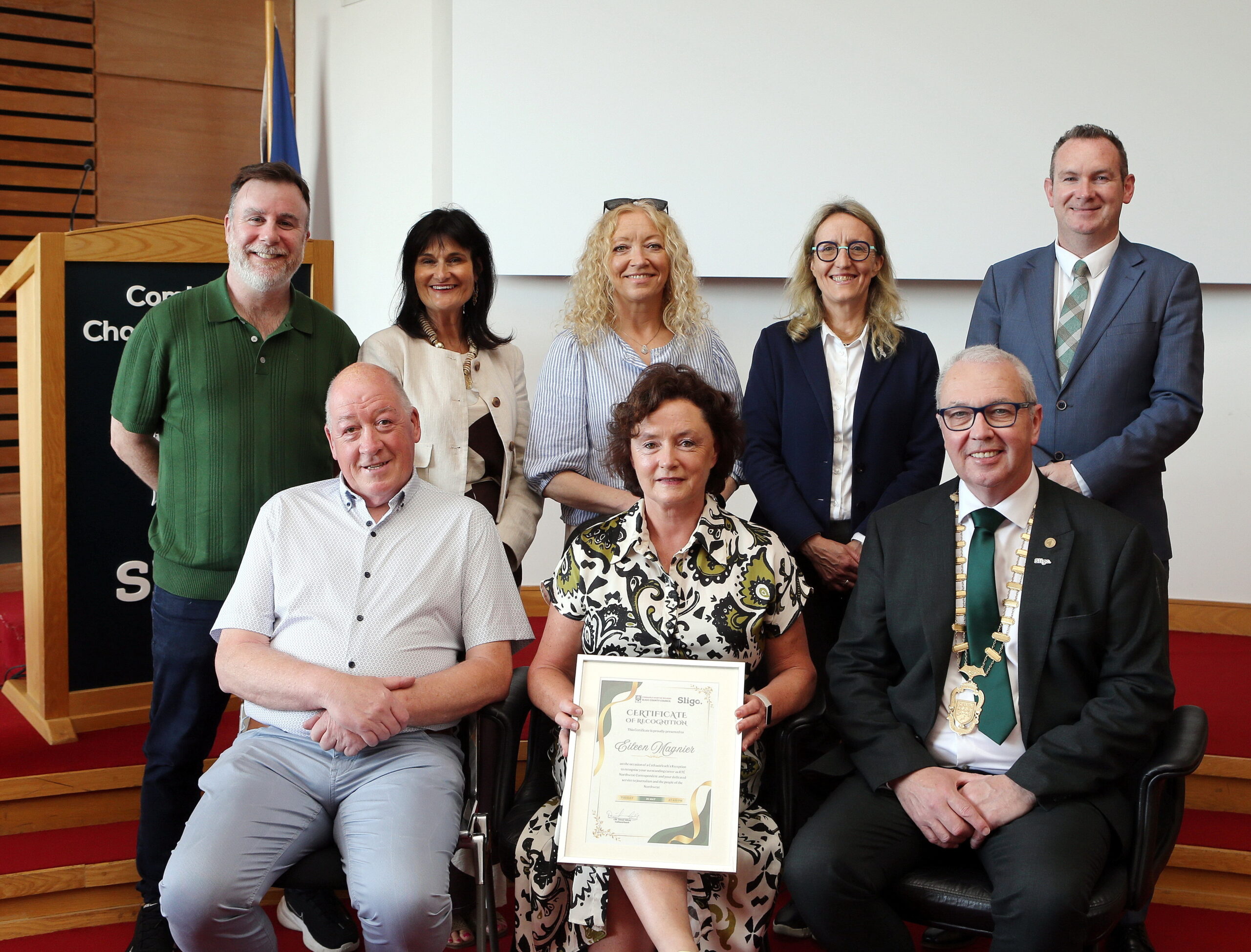
Cathaoirleach for Sligo county council Dónal Gilroy held a civic reception for country singer Sandy Kelly, ex RTÉ North West correspondent Eileen Magnier and sports performance psychologist Caroline Currid on Tuesday of this week. Cathaoirleach Gilory is in his last few weeks of his tenure as chair of Sligo county council and he wished to hold this event to “recognise three outstanding women who have made an exceptional contribution to Irish life”.
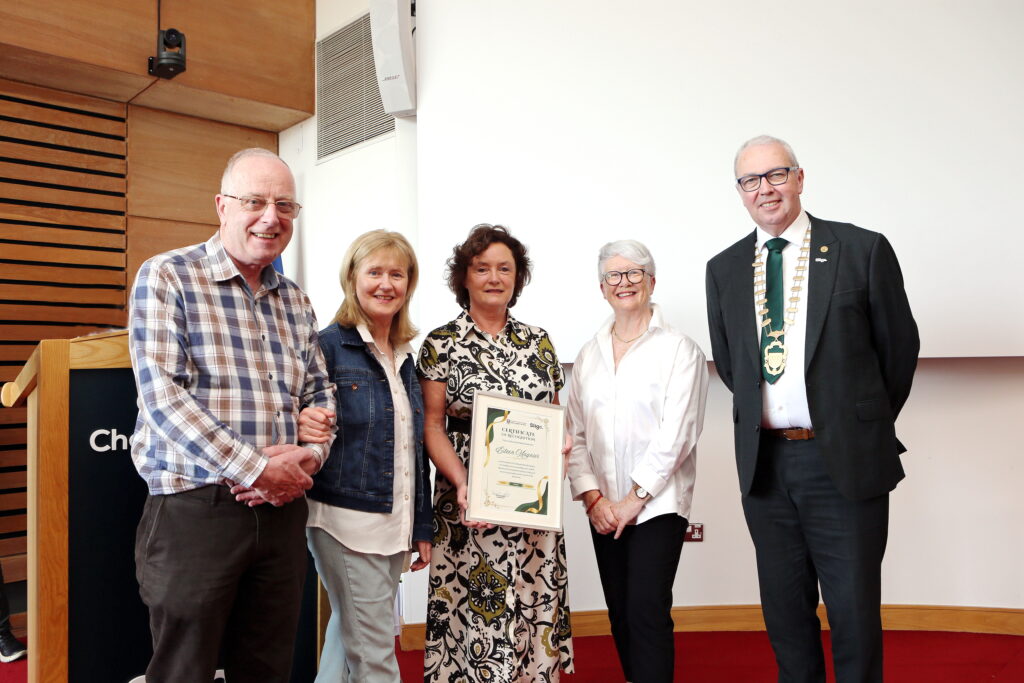
Both Sandy Kelly and Caroline Currid received their honours in absentia due to a family situation for Ms Kelly and Ms Currid was tied up with work commitments. Eileen Magnier was present at the event, alongside well known faces such as local ex-colleague and camera man John McMorrow and current RTÉ North West correspondent Shane Ó Curraighín.
Cathaoirleach Gilroy spoke about why he wished to hold this event, recognising the significance of three successful women of three different disciplines. He mentioned that Caroline is also from Grange, of the same parish as his own.
He acknowledged how she is a leading sports and performance psychologist and has been “sought after by experts”.
He also spoke about how she has worked with multiple teams such as Tyrone, Dublin and Limerick, as he said “we are immensely proud of her achievements”.
He then spoke about Sandy Kelly, as he said she “is one of the most iconic figures in Irish music with a career spanning over fifty years.”
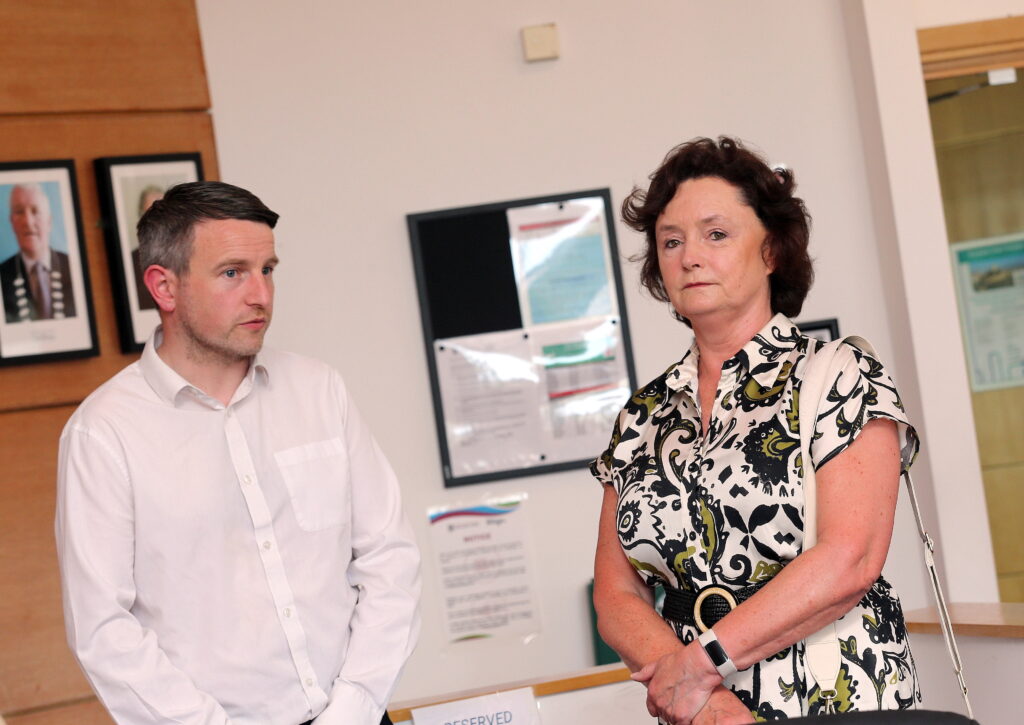
He mentioned how she represented Ireland in the 1982 Eurovision with The Duskeys, and describes how she gained international traction.
“Johnny Cash heard her on an Irish radio station and invited her to Nashville”, he said.
He concluded by saying her “songs have become part of the soundtrack of many people’s lives and she has made a lasting contribution to Irish music.”
Cathaoirleach Gilroy then acknowledged Eileen Maginer in the room as he called her “one of Ireland’s most trusted regional journalists.”
He also acknowledged the upcoming retirement of Eileen’s ex cameraman John McMorrow who was present at the event, as he said “everyone knew how much of an apprenticeship you both had together”.
Eileen then took to the stand to make a speech. She laughs as she recalls how when she first got the posting of RTÉ’s North West correspondent, she was nicknamed “the North-Wet correspondent” as a result of the weather conditions she had to report in.
She said that whenever she was announcing her retirement from the state broadcaster in 2024, she was “overwhelmed by the messages of people from around the country, even the president Michael D sent me a message, appreciating the work I’ve done”.
She is just back from a trip to Alaska, as she said she received the message from Cathaoirleach Gilroy there about this event and was confused by the honour as she laughed “sure I was just doing my job!”
She spoke to the Sligo Weekender after the ceremony about how the local community backed her throughout her career of 34 years as RTÉ’s North West correspondent.
“Initially, it was challenging because I was a blow in and a young woman, and I was replacing Tommie Gorman who was a very popular local person and a great journalist. So it took a bit of time I think to build the trust and the relationship with people and as well as that, the job wasn’t just Sligo – it was Donegal and Leitrim as well. You had to cover all the different areas – but I think just over time you got to know more people, make connections and people got to recognise you then.”
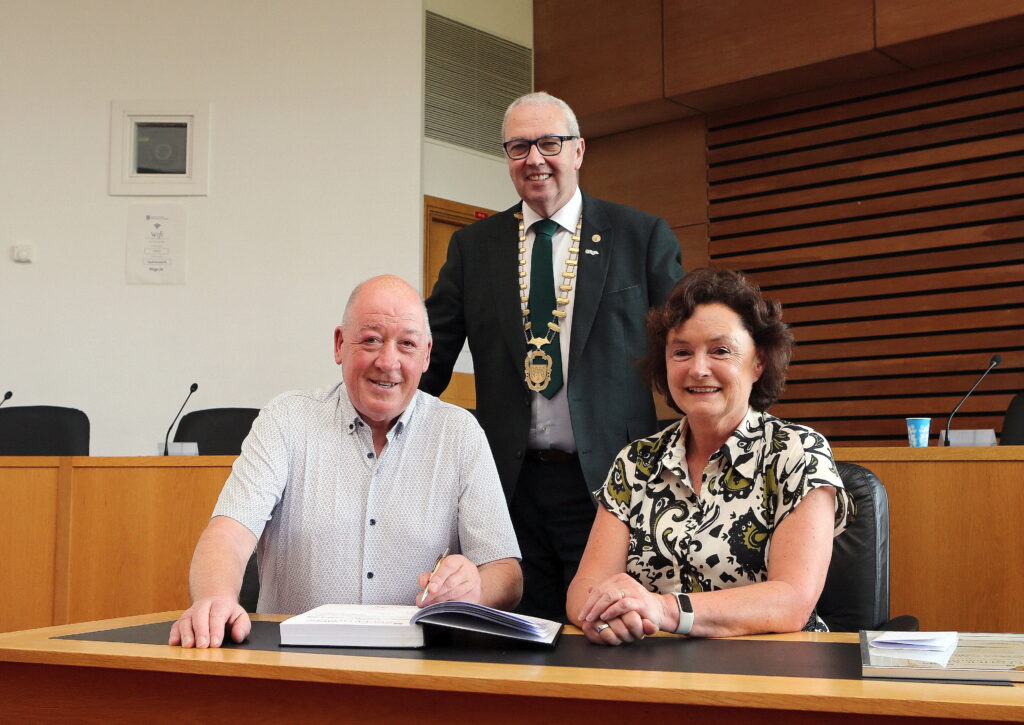
She described how she built up a good rapport with locals which helped her in her reporting too, “You would have people stopping you on the street telling you about things, giving you a call, finding your number from somebody and it was a slow process but once the reporting you’re doing is truthful and trustworthy – good journalism – then I think people acknowledged it.”
She explains how the various types of stories she covered throughout her tenure helped build a level of trust with the community, “We tried to do nationwide positive stories too, and that built a warmth with people as well, that they knew you weren’t just there for the bad days – you were there for the good days as well – which I think is really important as a regional correspondent, because as a regional correspondent you’re not just a news reporter, you’re kind of the face of the region – so you’re reflecting what’s going on in the region and representing the people to an extent.”
Magnier got married in county Sligo, and is married to TJ Kilgannon, former Mayo footballer. Their three kids grew up in the county and she said this also helped her with getting to know people in the area, as she is originally from Kilkenny.
“I think in the end, a lot of people wouldn’t have thought I was even a blow in! It was a slow building of trust, but I think it was ok in the end!”
She has been retired from RTÉ for a little under two years, as she says that retirement life is “brilliant”.
“I love it – I love the freedom of it. I suppose I just got to a stage where it was always hard to plan your life, and you missed out on a lot of things. I did a lot of [stories on] tragedies, and they take their toll in a way. You come to a point where you say, I’ve done that now, and I’ve done as good of a job that I could do on it, but I think it’s just time for me now to focus on my health and enjoy life. The kids were all grown up, so we had a bit more freedom that way as well.”
She says she has been travelling, exercising and has gotten involved in various different projects to keep herself occupied. One of her main interests is history and she explains how she is on the editorial board of the old Kilkenny review, which is the annual publication of the archaeological society there. Last year, she researched an article about a conman in Kilkenny in the 1800s and wrote an article on this topic for the review. She has also been doing various moderation and MC gigs too.
She has a masters in history and family from University of Limerick, and has done research into bigamists in Ireland in the 1800s. Another area that she finds fascinating is emigration as she says she has been doing her own genealogy in her family too. Last year, she took a trip to Australia to visit her son as she says she also carried out her own side quest there to trace two Magniers of her bloodline who were sent down under for being rebels in Cork. She says she enjoys tracing her roots and finding out new stories.
She remembers fondly the historic stories she has covered here in Sligo too, notably the megalithic sites and Sligo gaol.
She really hopes that Sligo’s passage tomb landscape gains the UNESCO World Heritage status, as it is currently on the tentative list. She also says that she hopes the gaol will get up and running too as a tourist location.
Asked if it is hard to distance herself from these stories now that she is sitting in the back seat, she says “it is lovely to follow on and see the developments, I don’t miss being in the thick of it anymore, or the deadlines!”.
She describes how she used to love reporting on elections and whenever the general election of 2024 came up, she nearly re-considered her decision to leave RTÉ. She was brought back to reality when she realised she could sit on the couch and watch it all fare out before her eyes on TV rather than the count centre.
“I sat on the couch, I actually lived on the couch for a couple of days! – with a glass of wine or tea or whatever, watching all the results coming in – but before you would be stuck in a count centre, but it was lovely now to get the bigger picture and different perspective.”
She says she particularly loves watching the TV whenever the weather is really bad and reporters have to brave the elements to carry out their work, as it reminds her of the countless times she had to do this herself.
“I used to always be stuck out there in the wildest places with your hair blowing everywhere and now I love watching it from my couch!”.